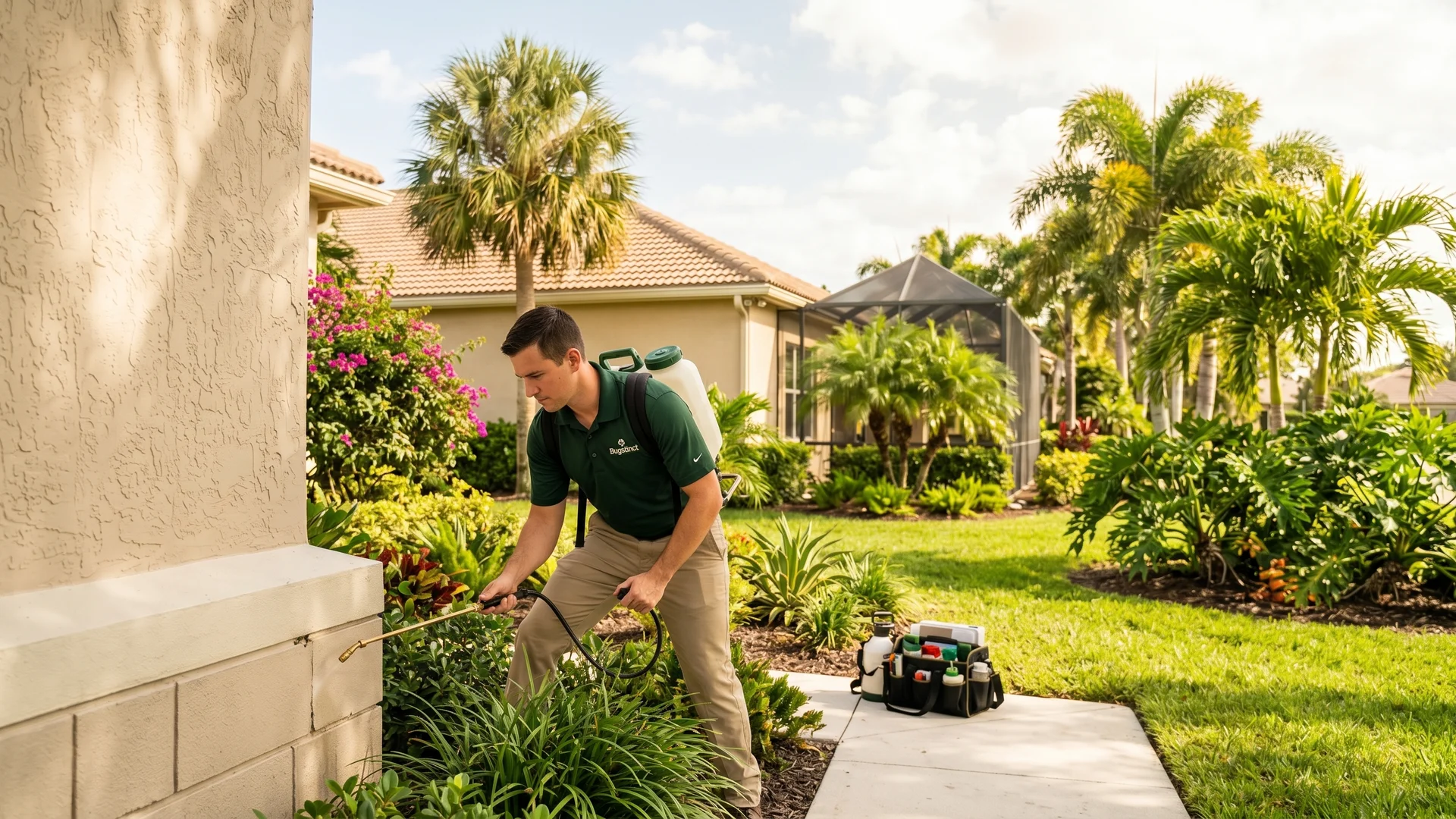
Insect Control FAQs -- Ants, Mosquitoes, Wasps, and More in South Florida
South Florida homeowners deal with a broader range of insect species than most of the country -- year-round, without seasonal relief. Ghost ants, fire ants, carpenter ants, mosquitoes, wasps, hornets, fleas, ticks, and occasional invaders like silverfish and earwigs are all active in Broward, Miami-Dade, and Palm Beach counties. These FAQs cover the insect control questions homeowners ask most -- organized by pest type.
- Ant control FAQs -- ghost ants, fire ants, and carpenter ants
- Mosquito treatment and prevention in South Florida
- Wasp and hornet nest questions and safety
- Flea, tick, and occasional invader control
Why Insect Control in South Florida Requires Species-Specific Approaches
The most important thing South Florida homeowners can understand about insect control is that treatment effectiveness depends almost entirely on using the correct product for the confirmed species. Consumer insect sprays are broadly repellent -- they cause insects to relocate rather than die. Ghost ants scatter to form new satellite colonies. German roaches retreat deeper into wall voids. Applying the wrong product to the wrong species consistently fails.
Professional insect control begins with species identification before any product is applied. Ghost ants and fire ants require non-repellent baits that workers carry back to the colony. German roaches require non-repellent gel bait with IGR. Mosquitoes require a combination of source reduction and residual treatment. Wasps and hornets require direct nest treatment at the right time of day. Each pest has its own protocol.
These FAQs explain the species-specific questions most commonly asked by South Florida homeowners before their first professional insect control visit.
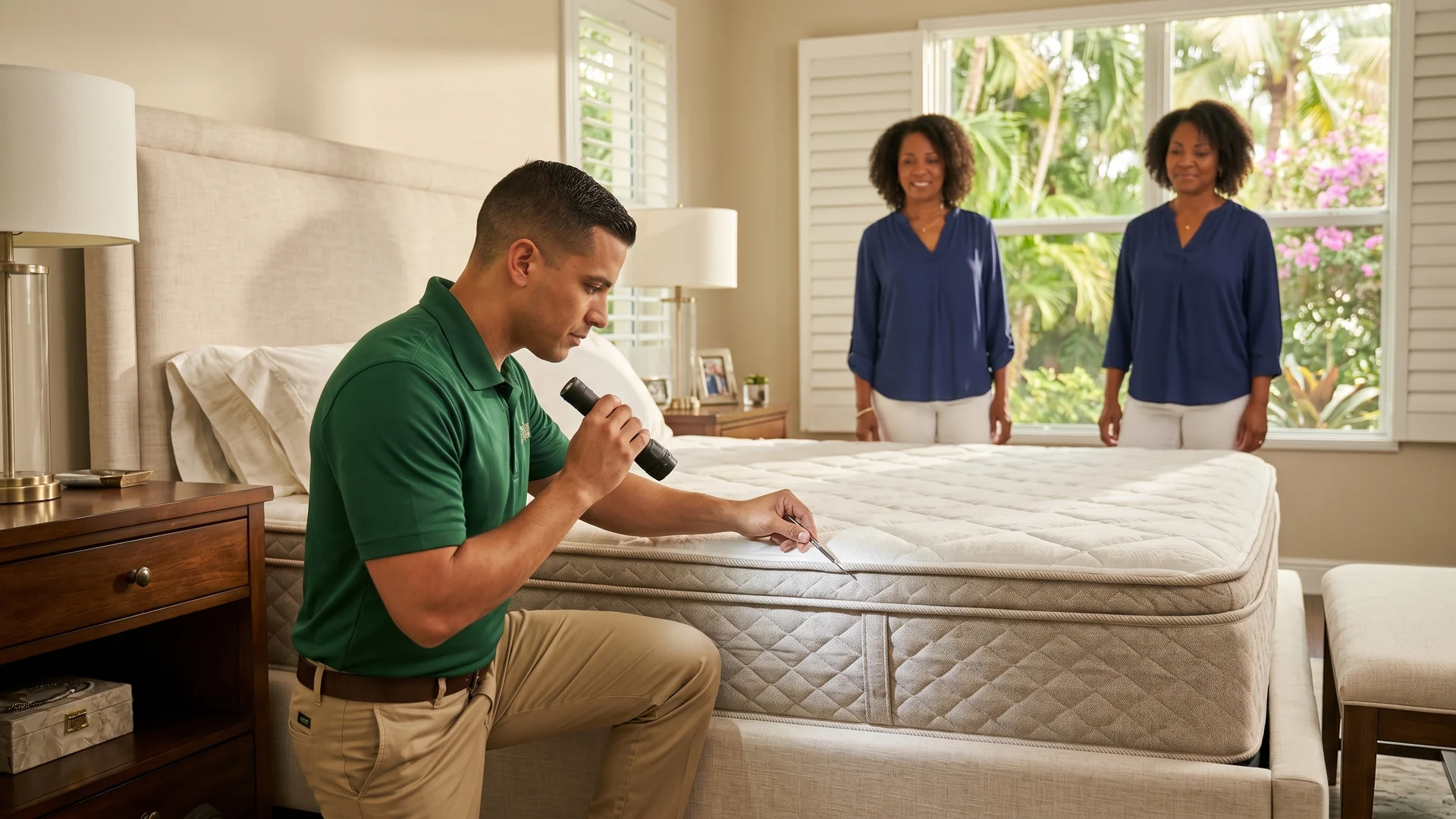
How Professional Insect Control Works by Species Type
Treatment approach varies significantly by insect species -- the protocol for ants is not the same as the protocol for mosquitoes or wasps.
Species Identification First
A licensed technician inspects the property to confirm the insect species, map active zones, and identify the likely harborage or breeding source. Applying the correct product for the wrong species always fails.
Ant Control Protocol
Ghost ants and pavement ants require non-repellent liquid bait applied at active trail locations. Fire ants require mound drench and broadcast granular bait. Carpenter ants require wood void inspection and targeted interior treatment. Repellent spray for any ant species causes colony scatter, not elimination.
Mosquito and Flying Insect Protocol
Mosquito control combines source reduction (standing water identification) with residual treatment on resting vegetation and shaded zones. Wasps and hornets receive direct nest treatment at dawn or dusk when activity is lowest. Yellow jackets in the ground require void injection.
Ongoing Prevention
Monthly pest management maintains the exterior barrier that reduces all insect species entry, refreshes residual treatment before dissipation, and catches new insect activity before it establishes indoors.
The Insect Species South Florida Homeowners Ask About Most
Ghost Ants -- Why They Are Everywhere and Why Spray Fails
Ghost ants (Tapinoma melanocephalum) are the most common ant species in South Florida homes. They are tiny -- about 1.5 mm -- with dark heads and translucent bodies, which makes them nearly invisible on light-colored surfaces. They form large super-colonies with multiple queens and dozens of satellite nests connected by foraging trails, which means that eliminating one nest location has no impact on the broader colony.
Repellent spray at ghost ant trail locations causes the colony to abandon that route and establish new trails in adjacent areas -- the colony does not die, it relocates. Non-repellent liquid bait applied at active trail locations is carried back to the colony and shared, reaching the queens and satellite nests that spray never contacts. Ghost ant elimination with correct protocol typically shows visible trail reduction within 48 to 72 hours.
- Ghost ants have multiple queens and satellite nests -- eliminating one nest does not solve the infestation
- Repellent spray causes trail scatter, not colony death
- Non-repellent liquid bait is carried back to queens and satellite nests
- HOA irrigated landscaping creates year-round ghost ant habitat adjacent to the home
Mosquitoes and Wasps in South Florida -- What Works
South Florida mosquito populations peak during the rainy season (June through September) but remain present year-round due to the subtropical climate. Professional mosquito control addresses both the current adult population with residual treatment on vegetation and shaded resting zones, and the breeding source with standing water identification and elimination. Without source reduction, residual treatment provides only temporary knockdown.
Wasp and hornet nests at entry points, in eaves, or under overhangs are common in South Florida. Consumer wasp spray can be effective for small, accessible nests treated at night -- but nests inside structures, in the ground, or in locations requiring a ladder are better handled by a licensed technician. Wasps aggressively defend nests and will pursue perceived threats. Multiple stings are a serious health risk for individuals with allergies.
Consumer Insect Spray vs. Professional Insect Control
| Comparison | Consumer Spray Products | Professional Insect Control |
|---|---|---|
| Ghost ant elimination | Repellent spray causes colony scatter -- infestation spreads | Non-repellent bait carried to colony -- queens eliminated |
| Fire ant treatment | Surface mound treatment does not address satellite colonies | Broadcast bait plus mound drench eliminates the colony network |
| Mosquito knockdown | Consumer fogger provides temporary knockdown only | Residual treatment plus source reduction provides lasting reduction |
| Wasp nest removal | Effective for small, accessible nests at night | Required for structural nests, in-ground nests, or elevated locations |
| Species identification | Typically applied based on what insect looks like | Confirmed by licensed technician before product selection |
| Guarantee | None | 30-day free re-treatment if insect activity returns |
Insect Control FAQs -- What South Florida Homeowners Ask Most Often
Why do I keep getting ghost ants in my kitchen no matter what I spray?
Are fire ants dangerous to treat myself?
How do I get rid of mosquitoes in my yard?
What should I do about a wasp nest near my front door?
Can I treat for fleas myself?
Do silverfish or earwigs indicate a moisture problem?
Are carpenter ants dangerous to my home?
How long does insect control treatment take to work?
Insect Control Services Bugstinct Provides in South Florida
Species-targeted insect control for all pest insects common to Broward, Miami-Dade, and Palm Beach counties.
Ant Control
Ghost ants, fire ants, and carpenter ants treated with species-appropriate non-repellent bait or colony-elimination protocols.
Mosquito Control
Source reduction identification and residual vegetation treatment to reduce adult populations and breeding sites year-round.
Wasp and Hornet Removal
Direct nest treatment and removal at entry points, eaves, and structural locations. Same-week priority scheduling for entry-blocking nests.
Cockroach Control
German roaches treated with gel bait and IGR. Palmetto bugs treated with exterior perimeter barrier and exclusion. No repellent spray in kitchens.
Flea and Tick Control
IGR-inclusive flea treatment addressing all life stages in carpeting and upholstery. Tick treatment at exterior resting zones and vegetation.
Occasional Invader Control
Silverfish, earwigs, millipedes, and other occasional invaders treated at interior moisture zones and exterior entry points.
Why Professional Insect Control Outperforms Consumer Products in South Florida
Species-targeted professional treatment consistently resolves insect problems that consumer products cannot.
Colony-Level Elimination
Non-repellent bait reaches the colony source -- queens, satellite nests, and reproductive adults that consumer spray never contacts. The infestation resolves, not just the visible trailing workers.
30-Day Guarantee
Professional insect control includes a 30-day guarantee. If insect activity returns within that window, Bugstinct returns for a free follow-up treatment.
Species ID Before Treatment
Every Bugstinct visit begins with species confirmation. Using the correct product for the confirmed species is the single most important factor in treatment effectiveness.
EPA-Registered Products
Insect control products are EPA-registered and applied at label-specified rates by FDACS-licensed technicians. Safe for children and pets when re-entry guidelines are followed.
Related Insect Control Resources
Insect Problem in Your South Florida Home? Get Expert Help.
Bugstinct provides licensed, species-targeted insect control across Broward, Miami-Dade, and Palm Beach counties with a 30-day guarantee. Same-week appointments available.